Holiday season scams targeting businesses: Black Friday, parcels, fake suppliers and gift cards
From Black Friday to the Christmas break, fraudsters exploit the flood of parcels, skeleton staff and year-end deadlines. Six scams to recognise, the right reflex for each, and the checklist to complete before the holidays.

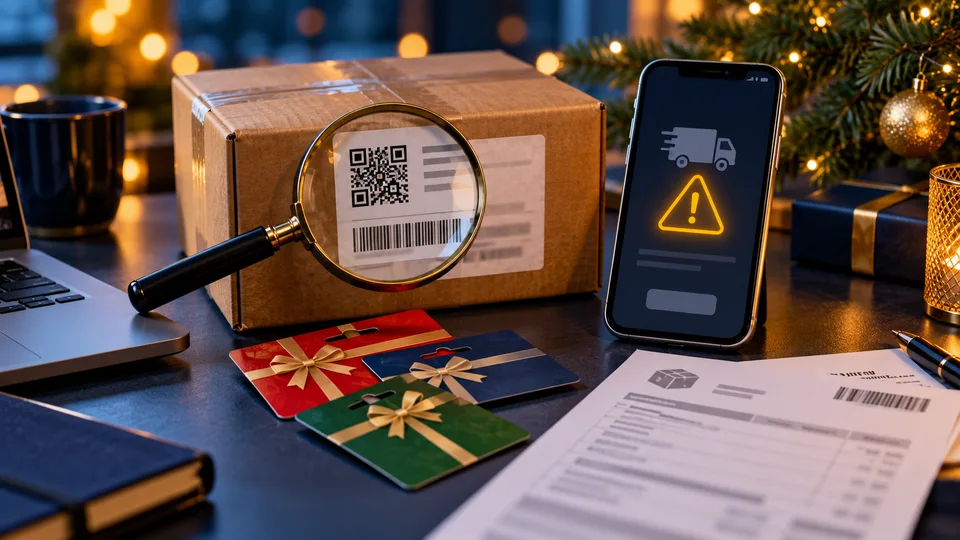
Friday 27 November 2026 is Black Friday; Monday 30 November, Cyber Monday. Then come the client gifts to order, the team party to book, the invoices to settle before year end and, as Christmas approaches, offices that empty out. For fraudsters, this is peak season: plenty of expected messages, few people around to check, and a good excuse to hurry.
This article covers the six scams that target businesses and their staff at this time of year, how to recognise each one, the right reflex, and the checklist to complete before the holidays.
Why year end is the fraudsters’ favourite season
Four factors pile up between November and January:
- volume: orders, shipping notices, promotions, greetings cards. A fake message blends into a mass of genuine ones;
- skeleton staff: holidays, long weekends, temps and stand-ins who know neither the suppliers nor the procedures;
- deadline pressure: budgets to spend, invoices to pay before 31 December, orders to place “before we close”;
- blurred lines between personal and work life: personal parcels tracked on the work phone, client gifts bought from whichever site shows the biggest discount.
Figures from Cybermalveillance.gouv.fr, the French government’s cyber victim assistance platform, set the scene for 2025. PhishingPhishingA scam that impersonates a trusted sender (a bank, a supplier, a colleague) by email, text message, phone call or QR code to trick the victim into clicking, handing over credentials or paying. was the top threat across all audiences, up 70%, and alone accounted for a third of assistance requests. Online shopping scams rose by 170%, fuelled by fraudulent websites that proliferated during the year.
Six scams to recognise
All of them rely on social engineeringSocial engineeringManipulation techniques that get a person to bypass security themselves: revealing a password, approving a payment, opening a door or installing software.: making an unusual request look normal, at a moment when you are too busy to check it.
1. The fake delivery notice
“ParcelExpress: we were unable to deliver your parcel. Pay a €1.49 redelivery fee within 24 hours.” The link leads to a copy of the carrier’s website asking for card details, sometimes for login credentials, sometimes to install a “tracking app” that is in fact malwareMalwareAny program designed to cause harm: stealing data, spying, encrypting or destroying files, or taking control of a device without its user knowing..
How to spot it. According to Cybermalveillance.gouv.fr, this was the most common phishing theme in 2025: a fake delivery problem and a payment of around 1 to 2 euros. In summer 2025 a harmless-looking first text appeared (“Hello, are you at home?”) with a single purpose: getting a reply so that links in the following messages become clickable.
The right reflex. Never click: find the parcel on the carrier’s website or app, typing the address yourself. Report the text (in France, forward it free of charge to 33700). And if the card entered was the company’s, have it blocked at once.
2. Fake promotions and fake shops
IT equipment, client gifts, supplies: Black Friday is a buying season for businesses too. Fake shops copy a well-known retailer or pop up for a single season, with unrealistic discounts, a countdown timer and invented reviews.
How to spot them. A price well below the market, a web address one character away from the real one, an unknown site with no history, manufactured urgency (“only 2 left”).
The right reflex. Buy from the company’s approved suppliers or from sites whose address you type yourself. For an unknown site, search its name with “reviews” before paying. Keep online purchases on a dedicated card with a low limit. Report fake shops to Phishing Initiative.
3. Fake suppliers and year-end payment fraud
December is when payments bunch up: order balances, deposits for next year, invoices to book “in this financial year”. The fraudster slips into an email thread with new bank details, or poses as a supplier “changing banks on 1 January”. A variant is the fake order confirmation, whose “cancel” button leads to a fake refund site.
How to spot it. A change of bank details, urgency tied to year end, a contact you don’t know because your usual one is “on holiday”.
The right reflex. Call back on a known number before changing any bank details, require two approvals, allow no exceptions. Our article on invoice fraud and CEO fraud sets out the procedure and what to do if the money has gone.
4. Gift cards requested by an “executive”
This is the seasonal version of CEO fraudCEO fraudA scam in which a fraudster poses as a senior executive, supplier or lawyer to get an employee to make an urgent, confidential bank transfer to an account the fraudster controls.. An email from the “managing director”: “Are you available? I need a discreet favour.” Then the request, often moved to a messaging app: buy gift cards to thank clients or the team, scratch off the codes and send photos, because they are “about to go into a meeting”. Reimbursement promised for tomorrow.
How to spot it. A personal or look-alike address, a quick move to a messaging app, a pressing and confidential tone and, above all, the request to send the codes.
The right reflex. The rule has no exceptions: as the US Federal Trade Commission puts it, no real business or government agency will ever tell you to buy a gift card to pay them. Call the executive back on their usual number. If codes have been sent, contact the card issuer immediately, as it can sometimes freeze the balance, and keep the cards and receipts.
5. Rigged QR codes (quishing)
An “HR” email asks staff to scan a QR code to view their year-end bonus or approve the holiday rota. A sticker covers the QR code on a parking meter or charging point. The principle never changes: the QR code hides its destination, and the scan happens on a phone that is often less protected than the work computer.
How to spot it. A QR code received by email to sign in to a work account, a sticker placed over another code, an address shown after scanning that has nothing to do with the organisation.
The right reflex. France Num, the French government’s digital programme for small businesses, advises checking that the code is not stuck over another one, reading the address before opening it and giving up if in doubt. To sign in or pay, use the official app or type the address yourself. Multi-factor authenticationMulti-factor authentication (MFA)A login that requires at least two proofs of identity of different kinds (something you know, something you have, something you are), so that a stolen password is no longer enough. limits the damage if a password is stolen: see our article on MFA and passkeys for small businesses.
6. Fake booking sites for the team party
A cottage for the away day, a room for the Christmas dinner, a caterer: an attractive listing and an “owner” who suggests paying the deposit by direct transfer, outside the platform, “to avoid fees”. Once paid, nobody answers.
How to spot it. A price too good for the date, a hurried contact who wants to leave the platform, payment requested by transfer abroad, money order, money transfer service or prepaid voucher.
The right reflex. Cybermalveillance.gouv.fr advises always paying through the platform’s own payment method and refusing cash, money transfer services and vouchers. For a venue booked directly, check that it exists (reviews, landline, visit) and confirm the booking by phone.
Fraud (escroquerie) carries up to five years’ imprisonment and a €375,000 fine under Article 313-1 of the French Criminal Code. A police complaint, backed by the evidence you have kept, is the starting point for any action, including with your bank or insurer.
At a glance: the signal and the reflex
| Scam | The signal | The right reflex |
|---|---|---|
| Fake delivery notice | Small fee to pay, shortened link | Track on the official site, report the text |
| Fake shop | Unrealistic price, altered address | Approved supplier, search for reviews |
| Fake supplier | New bank details, year-end urgency | Call back, two approvals |
| Gift cards | “Executive” in a meeting, codes to send | Never send codes, call a known number |
| Rigged QR code | Sign-in requested after a scan | Official app, read the address |
| Fake booking site | Payment outside the platform, vouchers | Pay via the platform, phone the venue |
The “before the holidays” checklist
To complete in the week before closing, with whoever runs IT (in-house or provider) and the accounts team.
Accounts and access
- Accounts of this year’s leavers, interns and finished contractors are disabled.
- Multi-factor authentication is on for email, online banking and remote access.
- Administrator accounts are named and kept to the bare minimum.
- Automatic forwarding rules on mailboxes have been reviewed.
On-call and continuity
- Someone is on call for every closed day, with a backup.
- Pending updates are installed before leaving, not during the break.
Payment procedure
- No change of bank details is processed during the closure without a call-back.
- Two-approval thresholds stay in force, and stand-ins know them.
- The rule is restated in writing: no gift card purchases on request by message.
Backups
- A full 3-2-1 backup3-2-1 backup ruleA simple backup rule: 3 copies of your data, on 2 different types of media, with 1 kept off-site. is taken just before closing, including an offline copy.
- A restore has been tested recently (one file, one mailbox).
Who to call
- The emergency contact sheet below is posted up and shared on phones.
Who to call, who to alert (France)
| Situation | Contact |
|---|---|
| Incident under way, need help assessing it | 17Cyber, online assistance from the police, gendarmerie and Cybermalveillance.gouv.fr |
| Unsure whether it is a scam | Info Escroqueries, 0 805 805 817 (free, Monday to Friday, 9 am to 6.30 pm) |
| Suspicious text or MMS | Forward free of charge to 33700, or 33700.fr |
| Suspicious email | Signal Spam |
| Fake website | Phishing Initiative |
| Card details entered, transfer sent | Your bank, on its usual number, immediately |
| Loss suffered | Complaint at a police station or gendarmerie |
For a more serious attack (hijacked accounts, encrypted computers), follow the incident responseIncident responseThe organised set of actions taken to detect an attack, limit the damage, drive the attacker out, restore operations and learn the lessons. steps in our article Ransomware attack: what to do.
Parcel, promotion, new bank details, gift card, QR code: don’t click, don’t pay, check through another channel. In doubt? Call the on-call contact. Nobody will ever blame you for checking.
Train your teams before the festive season
A checklist only protects you if everyone recognises the trap when it lands on their phone between two meetings. A few minutes are enough to refresh the reflexes before the busiest period. The KrakenShield Academy offers staff short modules, including one on phishing and one on CEO fraud, to complete before the holidays. To go further, the chapter Phishing, social engineering and physical intrusion of “Cyber A to Z” covers every technique.
Key takeaways
- Never act on a delivery text through its link: track the parcel on the carrier’s website by typing the address yourself, and report the message (in France, forward it to 33700).
- No executive ever asks you to buy gift cards and send the codes: it is always a scam. Hang up and call back on a number you already know.
- Payment procedures don’t take holidays: call back before accepting any new bank details, two approvals, no exceptions for year-end urgency.
- A QR code hides its address: read it after scanning, and never sign in to a work account from a QR code received by email.
- Before the break: close unused accounts, check multi-factor authentication, test a backup, name an on-call contact and post the emergency numbers.
Frequently asked questions
How can I spot a fake parcel delivery text?
It claims there is a delivery problem and asks you to click to pay a small fee (often 1 to 2 euros) or confirm an address. The link leads to a site imitating the carrier, built to steal card details. The right reflex: never click, find the parcel on the carrier’s official website or app, and report the text (in France, by forwarding it to 33700).
I clicked on a fake parcel text. What should I do?
If you entered a payment card, have it blocked by your bank immediately. If you gave a password, change it everywhere you used it. If an app was installed, disconnect the phone and have it checked. Keep the message and report it. In France, 17Cyber and the Info Escroqueries hotline (0 805 805 817) can guide you.
How do I report a scam text message in France?
Forward it to 33700 (free of charge) or report it on 33700.fr with a screenshot or a form. Reports are passed to the mobile operators every day, so they can block the numbers involved. Suspicious emails go to Signal Spam and fraudulent websites to Phishing Initiative.
Why do scammers ask for gift cards?
Because a gift card works like cash: once the code is shared, the balance is spent or resold, with no trace and no recourse. No genuine business or government agency asks to be paid in gift cards. If codes have been sent, contact the card issuer at once: it can sometimes freeze the balance.
What is quishing?
It is phishing by QR code. The code, slipped into an email or PDF or stuck on a poster, leads to a fake sign-in or payment page, or even to a malicious app. Because you cannot see the address before scanning, read it carefully afterwards, and use the official app to sign in or pay.
Sources
- Cybermalveillance.gouv.fr, press release on the 2025 activity report (26 March 2026, in French)
- Cybermalveillance.gouv.fr, Phishing in 2025: an omnipresent, massive and diverse threat (1 June 2026, in French)
- Cybermalveillance.gouv.fr, Smishing, or phishing by text message (in French)
- Cybermalveillance.gouv.fr, What to do about phishing (fact sheet, in French)
- Cybermalveillance.gouv.fr, Sales: 7 tips to avoid online scams (updated 11 August 2026, in French)
- Cybermalveillance.gouv.fr, Rental scams: payment methods to refuse and Article 313-1 of the French Criminal Code (in French)
- France Num (French Directorate General for Enterprise), QR codes: security and precautions (updated 25 March 2024, in French)
- US Federal Trade Commission, Avoiding and reporting gift card scams
- 33700, French platform for reporting spam texts and nuisance calls (in French)
- 17Cyber, French online assistance for victims